A Beginner’s Guide to Buying Property in Dubai (Step-by-Step, Costs, and Smart Tips)
Learn how to buy property in Dubai: who can buy, freehold vs leasehold, 10 steps, fees, mortgages.

If you’re planning to buy a home or an investment in Dubai, you’re in the right place. The city welcomes buyers of all nationalities and the process is regulated, transparent, and fast when you know the steps. In this beginner’s guide, you’ll learn exactly how to buy property in Dubai—who can buy, freehold vs leasehold, the 10-step purchase process, financing rules, fees and closing costs, best areas to consider, and the practical checks that keep you out of trouble.
Who can buy in Dubai—and what you can buy
Dubai’s property market is governed by Law No. 7 of 2006 (Real Property Registration Law) and overseen by the Dubai Land Department (DLD) and its regulator, RERA. Here’s what that means for you:
- Eligibility
- UAE and GCC nationals: can own property across Dubai.
- Foreigners (non-GCC): can buy freehold in designated zones or take long-term leasehold elsewhere.
- Property purposes: You can buy residential or commercial property in freehold zones.
- Oversight and registration: The DLD registers ownership and issues title deeds; RERA standardizes forms and regulates brokers.
Freehold vs leasehold in Dubai (explained)
- Freehold: Full ownership of the unit and a share of the land, indefinitely. You can sell, lease, or bequeath.
- Leasehold: The right to use/occupy for a fixed term (often up to 99 years). After expiry, rights revert to the freeholder.
- Why this matters: Freehold generally has stronger resale liquidity and easier financing; leasehold can impact bank appetite, valuation, and exit value.
The Dubai property purchase process (ready properties) in 10 steps
- Set your goal and budget
- End-user: prioritize commute, schools, amenities, and building quality.
- Investor: focus on net yield and price-per-sq-ft value—not glossy marketing.
- Ensure your funds are accessible in the UAE for deposits, manager’s cheques, and fees.
- Get mortgage pre-approval (if financing)
- Strengthens your offer and sets a realistic budget. Validity typically 60–90 days.
- Documents (salaried): passport, visa/Emirates ID (if resident), salary letter, 6 months’ bank statements, payslips.
- Self-employed: trade license, MOA, company bank statements, audited financials.
- Non-residents: passport, income proof, 3–6 months’ bank statements (policy varies by bank).
- Choose a RERA-registered agent (and consider a conveyancer)
- Your agent shortlists communities, arranges viewings, and negotiates.
- A conveyancer coordinates legal checks, NOC, bank/developer liaison, and DLD Trustee transfer.
- Research communities and view properties
- Compare amenities, access, schools, service charges (check RERA’s Service Charge Index), and rental demand.
- Popular beginner-friendly areas: Business Bay, JVC, JLT, International City, Palm Jumeirah.
- Due diligence before offering
- Verify the title deed and ownership via DLD channels (e.g., the Dubai REST app).
- Check service charges with the OA; confirm any outstanding dues, liens, or utility bills.
- Confirm tenancy status (vacant on transfer vs with tenant). If you plan to move in, understand the 12-month eviction notice requirement after transfer.
- Make an offer
- Agree price, target transfer date, inclusions, and key conditions (e.g., vacant on transfer, mortgage clause, repairs).
- Sign the MOU (RERA Form F)
- Form F captures price, dates, penalties, occupancy, and inclusions.
- Standard practice: a 10% deposit manager’s cheque per agreed terms, and agency commission (often 2% + VAT).
- Ensure the MOU specifies timelines, penalties, valuation/mortgage contingencies, and prorations (rents, service charges).
- Developer/OA NOC
- Seller obtains a No Objection Certificate confirming all dues are settled and the developer has no objection to transfer. Fees vary by developer.
- Settle any seller’s mortgage (if applicable)
- Seller gets a liability letter. The buyer’s bank (or the buyer if cash) clears the outstanding amount to release the property; allow 1–2 weeks.
- Transfer at a DLD Trustee Office
- Attend with original IDs, signed Form F, NOC, and manager’s cheques for the purchase price, DLD transfer fee (4%), trustee/admin fees, and agency commission.
- On completion, DLD issues your Title Deed and you receive keys and access cards.
Timeline and stakeholders
Expect 30–60 days from offer to transfer. Cash deals can complete in 2–3 weeks once documents are ready. Stakeholders include you and the seller, your agents, a conveyancer (optional but helpful), the developer/owners’ association, your bank (if financing), and the DLD Trustee Office.
Costs and closing fees: what to budget (beyond the price)
- DLD transfer fee: 4% of purchase price.
- Agency commission: commonly 2% + VAT (off-plan direct from developer often 0%).
- Mortgage registration: 0.25% of the loan amount + small admin/knowledge fees.
- Bank fees: processing (often ~1% of loan), valuation (~AED 2,600–3,200), and insurance (life/property if required by the bank).
- Trustee transfer fee: AED 2,000 + VAT (under AED 500,000) or AED 4,000 + VAT (AED 500,000+).
- Developer/OA NOC: varies by developer.
- Conveyancing fee: fixed fee, varies by provider.
- Title deed issuance/admin: approximately AED 2,500–5,000.
- Utilities and move-in: DEWA security deposit and connection, chiller deposits (if applicable), OA move-in permit.
- Ongoing: annual service charges, maintenance/sinking fund, insurance.
Rule of thumb: for a cash ready purchase, plan on roughly 7–8% in total transaction costs (4% DLD + ~2% agency + trustee + deed fees). Mortgages add loan-related costs.
Worked example: financed purchase (illustrative)
| Item | Basis | Amount |
|---|---|---|
| Purchase price | — | AED 1,500,000 |
| Buyer deposit (expat, typical) | 20% of price | AED 300,000 |
| DLD transfer fee | 4% of price | AED 60,000 |
| Agency commission | 2% + VAT of price | ~AED 31,500 |
| Mortgage registration | 0.25% of loan (AED 1.2m) | AED 3,000 + admin |
| Bank processing | ~1% of loan | AED 12,000 |
| Valuation | fixed | AED 2,500–3,500 |
| Trustee/admin fees | fixed per DLD schedule | AED 4,000 + VAT (if AED 500k+) |
| Title deed/admin | fixed | ~AED 2,500–5,000 |
Beyond the down payment, your upfront cash outlay can easily exceed AED 100,000—budget for contingencies.
Mortgage basics in Dubai (residents and non-residents)
- Minimum deposit/LTV:
- UAE expatriate residents: typically up to ~80% LTV on a first home (≈20% deposit).
- UAE nationals: up to ~85% LTV (≈15% deposit).
- Non-residents: often up to ~60% LTV (≈40% deposit), criteria vary by bank.
- Rates and structures: variable rates linked to EIBOR (plus margin), and fixed/hybrid options (often 3–5 years).
- Pre-approval first: improves negotiation power and avoids delays.
- Key costs: bank processing (~1%), mortgage registration (0.25% of loan + admin), valuation, life/property insurance.
- Off-plan note: mortgages generally start at completion/handover; developers fill the gap with payment plans.
Off-plan vs ready: which suits your goal?
- Ready properties
- Pros: immediate move-in/rent, bank financing available, you inspect the actual unit, clearer rent comps.
- Cons: larger upfront capital; fewer developer payment plan options.
- Off-plan (under construction)
- Pros: lower entry point, staged or post-handover payment plans, potential gains as the community builds out.
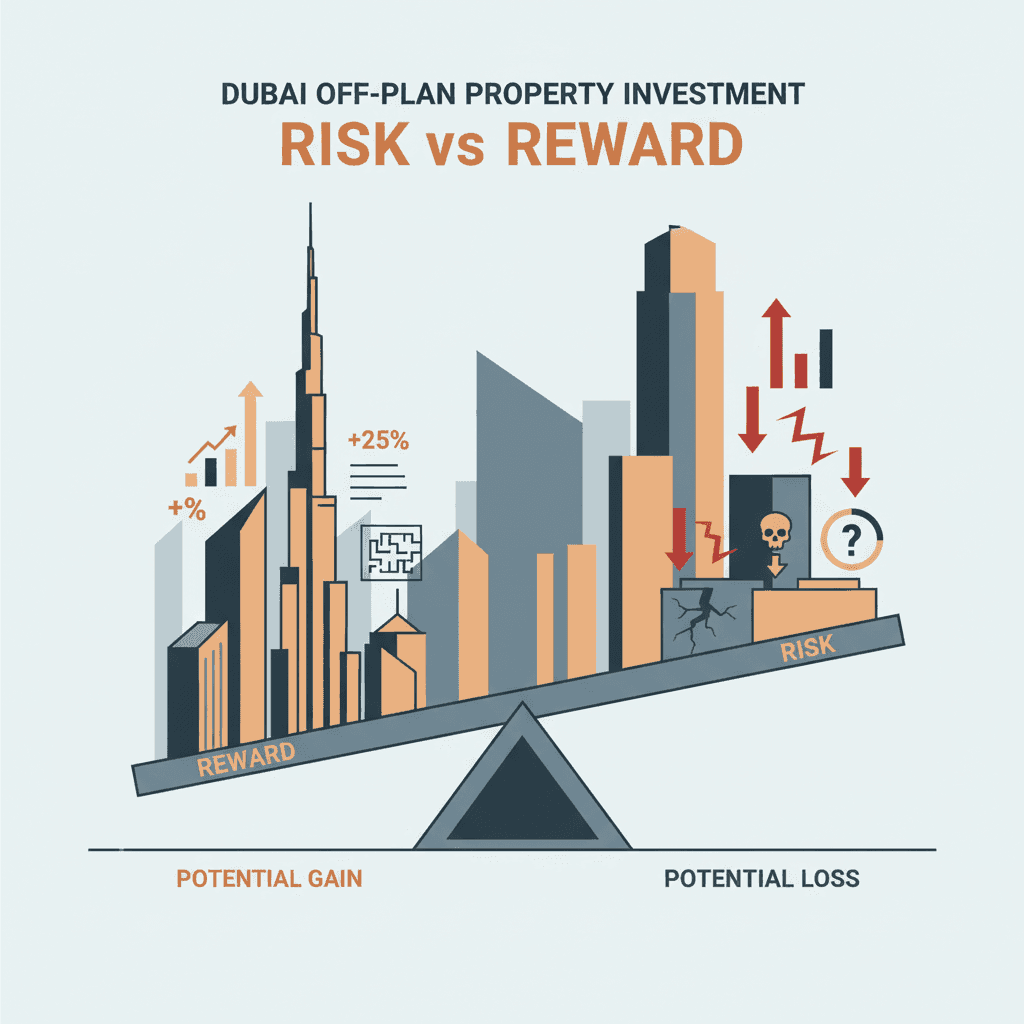
- Cons: delivery/timeline risk; resales often restricted until 30–50% is paid (per SPA); “flipping” is competitive and timing-sensitive.
- Process: reserve unit (URF), sign the SPA, pay installments into a RERA-regulated escrow account, register via Oqood, snag and handover, title deed issued at completion.
Best areas to buy (by purpose and budget)
- Business Bay: central, high rental demand, mixed-use towers—good for yield and liquidity.
- Jumeirah Village Circle (JVC): value-led entry prices, wide choice of apartments/townhouses—popular with first-time buyers.
- Jumeirah Lake Towers (JLT): established community, lakeside living, strong commuter appeal near DMCC—steady investor favourite.
- International City: budget-friendly with pockets of solid rental yields.
- Palm Jumeirah: premium beachfront, brand-led demand, strong resale for quality units.
Beyond these, weigh master-developer communities (e.g., Dubai Hills Estate, Arabian Ranches, Emaar Beachfront) for cohesiveness and long-term appeal vs multi-developer districts for wider choice and entry-level value.
Documents checklist (buying and financing)
- Individuals (salaried): passport, visa and Emirates ID (if resident), salary certificate, 6 months’ bank statements, payslips, proof of address.
- Self-employed: passport, visa/Emirates ID, trade license, MOA, audited financials, company bank statements.
- Corporate buyers: trade license, MOA, board resolution/POA, passports/IDs of authorized signatories.
Due diligence that saves money (and common pitfalls)
- Validate ownership and unit status via DLD/Dubai REST; inspect the title deed and any liens or outstanding dues.
- Check service charges and trend; high AED/sq ft charges can erode net yields.
- Tenancies: you inherit the lease; rents and deposit are prorated. For own-use eviction, a 12-month notice via notary/registered mail after you hold title is typically required.
- Don’t buy hype: verify rent comps and calculate net yield. Be cautious with late-phase off-plan “flips.”
- Mind supply: large waves of luxury/hotel-branded stock are slated for 2028–2030—set expectations accordingly.
- Plan for timeline friction: liability and clearance letters (seller’s mortgage), NOC scheduling, and bank coordination can add weeks.
After transfer: move-in and setup checklist
- Utilities: set up DEWA; arrange chiller, gas, and internet.
- Owners’ association: register, obtain access cards and a move-in permit if required.
- Insurance: home (and life insurance if mortgaged).
- Snagging & maintenance: document and resolve any issues; keep records of handover condition.
- If renting out: register Ejari; for holiday homes, obtain a DTCM permit and confirm building rules allow short stays.
Residency pathways and taxes (quick notes)
- Residency via property: Dubai offers property-linked residency options (e.g., the 10-year Golden Visa for qualifying investments). Always verify current thresholds and criteria on official UAE portals before committing.
- Taxes: no stamp duty and no recurring municipal property tax on owned homes. You’ll pay the 4% DLD transfer fee at purchase. Rental income isn’t subject to personal income tax, but corporate tax or VAT may apply if purchasing via a company or for certain commercial transactions—seek tailored advice.
FAQs: Dubai property buying guide
Can foreigners buy property in Dubai?
Yes. Non-GCC nationals can buy freehold in designated areas and long-term leasehold elsewhere.
What’s the difference between freehold and leasehold?
Freehold grants full, indefinite ownership. Leasehold grants usage rights for a fixed term (often up to 99 years), which can affect financing and resale.
What is Form F (MOU) in Dubai real estate?
It’s the RERA-standard Memorandum of Understanding that sets the agreed sale terms: price, dates, penalties, inclusions, and occupancy status.
What are the total costs/fees to buy a property in Dubai?
Budget for DLD transfer (4%), agency commission (often 2% + VAT), mortgage registration (0.25% of loan), bank fees, trustee/admin, NOC, and title deed issuance. Cash buyers typically see ~7–8% all-in costs on top of price; mortgages add loan-related fees.
What documents do I need for a mortgage pre-approval?
For residents: passport, visa, Emirates ID, salary certificate/payslips, and 6 months’ bank statements. Self-employed add trade license, MOA, and financials. Non-residents provide passport, income proof, and bank statements (bank policies vary).
How long does the buying process take?
Typically 30–60 days from offer to transfer. Cash deals can be faster once documents are ready.
What’s the minimum deposit in Dubai?
Expats commonly need at least 20% on ready property (UAE nationals often 15%). Non-residents usually need more (often ~40%).
How do I transfer ownership and get the title deed?
You and the seller (or authorized representatives) attend a DLD Trustee Office with IDs, Form F, NOC, and manager’s cheques for the purchase price and fees. DLD issues the title deed in your name (and the bank’s, if mortgaged) at completion.
Can I mortgage an off-plan property?
Generally not until completion/handover. Developers typically offer staged or post-handover payment plans; banks may finance after handover based on valuation and eligibility.
Helpful official links
Your 10-step action plan (quick recap)
- Define your goal (home, yield, or appreciation) and timeline.
- Set a budget including all fees; secure mortgage pre-approval if needed.
- Pick 2–3 target areas (master-developer vs multi-developer logic).
- Shortlist developers and buildings with strong delivery and management.
- For investors: build rent comps, estimate net yield, and check service charges.
- View properties or visit off-plan sites; verify on-the-ground realities.
- Negotiate price and terms; confirm vacancy or tenancy status.
- Sign RERA Form F (MOU), pay the deposit, and start the NOC process.
- Prepare manager’s cheques; coordinate bank, developer, and trustee scheduling.
- Complete transfer, collect your title deed, and arrange move-in or leasing.
Dubai’s real estate system is built for clarity: regulated forms, escrow protection for off-plan, and a predictable transfer process. If you budget for the true all-in costs, secure pre-approval early, and do the right due diligence, you’ll buy with confidence and avoid the common pitfalls.