Freehold vs Leasehold Real Estate in Dubai: The Complete 2025 Guide
Freehold vs leasehold in Dubai real estate: laws, areas, Golden Visa, mortgages, 2025 guide.
Choosing between freehold and leasehold in Dubai isn’t a small detail—it defines your rights, financing options, visa path, and resale strategy. If you’re weighing “freehold vs leasehold real estate Dubai,” this guide breaks down the difference in plain English, shows you where each is available, and helps you decide which model fits your goals.
Freehold vs Leasehold in Dubai, explained
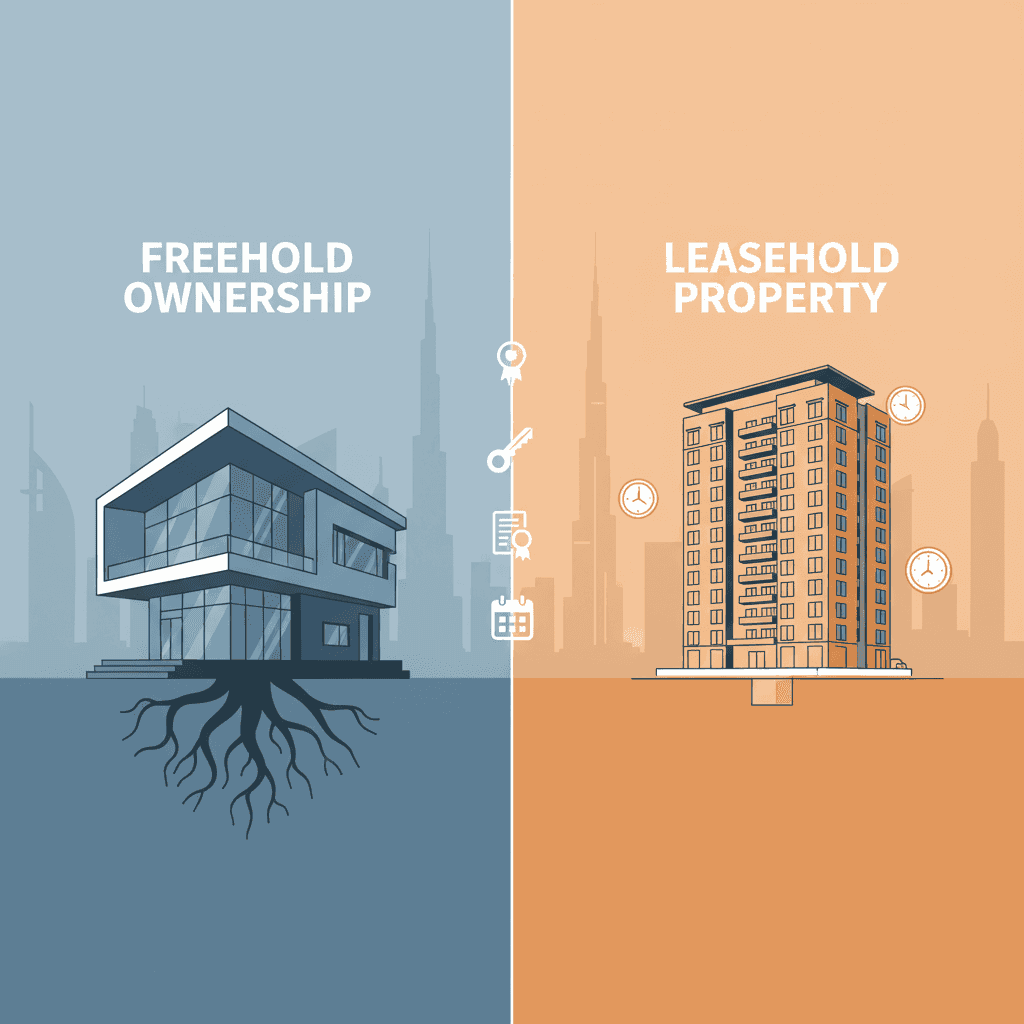
Freehold property (fee simple ownership) means you own the unit and an undivided share of the land/common areas in perpetuity. Your name appears on a Title Deed issued by the Dubai Land Department (DLD). You can live in it, lease it, sell it, mortgage it, or pass it to heirs without a time limit—subject to community and planning regulations.
Leasehold property gives you the right to use and benefit from a unit for a fixed term—commonly 30–99 years (30/60/85/99-year terms are typical). You don’t own the underlying land. Long-term leases in Dubai may be recorded as usufruct or musataha rights and must be registered with DLD. When the lease expires, rights typically revert to the freeholder unless a renewal is agreed.
The legal framework and registration (what the laws say)
- Freehold ownership: Governed by Dubai Law No. 7 of 2006 concerning Real Property Registration. Titles are registered with DLD; transfers are recorded and transparent.
- Leasehold/long-term use rights: Governed primarily by Dubai Law No. 26 of 2007 (as amended) on landlord–tenant relationships. Long-term leases/usufructs are also registered with DLD and must clearly state the term, rights, and obligations.
Bottom line: Freehold = perpetual ownership in designated zones. Leasehold = time-bound rights to occupy/use, not land title.
Freehold vs leasehold at a glance
| Aspect | Freehold property in Dubai | Leasehold property in Dubai |
|---|---|---|
| Ownership rights | Own the unit and an undivided share of land, indefinitely | Right to use/occupy for a fixed term (e.g., 30–99 years) |
| Tenure | Permanent (no expiry) | Expires at term end; reversion to freeholder unless renewed |
| Renovations/alterations | Broad freedom, subject to building/community approvals | Often requires freeholder/landlord consent for changes |
| Maintenance | Owner maintains the unit; pays community service charges | Major structural upkeep often on the freeholder/management; service charges still apply (check lease) |
| Financing | Widely mortgageable with competitive LTVs and rates | Mortgageable, but lender criteria tighten as remaining term shortens |
| Visa eligibility | May qualify for residency, including the 10-year Golden Visa (e.g., AED 2M+), subject to current rules | Less commonly linked to visas; confirm structure and current policy |
| Investment appeal | Stronger long-term capital appreciation and liquidity | Lower entry price; higher initial yields possible; sensitivity to term “time decay” |
| End of term | Not applicable | Unit reverts to freeholder unless renewed; renewal terms are by agreement |
Where each tenure is found in Dubai
Designated freehold areas popular with foreign buyers include:
- Downtown Dubai
- Dubai Marina
- Palm Jumeirah
- Business Bay
- Dubai Hills Estate
- Dubai Creek Harbour
- Jumeirah Lake Towers (JLT)
- Jumeirah Village Circle (JVC)
- Arabian Ranches
- Tilal Al Ghaf
Note: Some historically non-freehold districts now feature freehold projects (e.g., City Walk and La Mer/J1 Beach in the wider Jumeirah area), expanding choice for expats.
Areas commonly associated with leasehold (or where freehold for foreigners is limited) include:
- Jumeirah, Al Wasl, Al Safa, Al Manara, Umm Suqeim, Umm Al Sheif
- Al Barsha, Al Mizhar, Al Warqaa, Mirdif
- Examples of leasehold communities: Dubai Silicon Oasis, Green Community (DIP), parts of Jebel Ali and Dubai Investments Park, and specific assets like Dubai World Trade Centre Residences (99-year lease)
Always verify a project’s exact status (freehold vs leasehold) and your eligibility before you sign.
Pros and cons for investors and end-users
Freehold advantages
- Full control to occupy, lease, sell, or gift; straightforward generational wealth planning
- Typically stronger capital appreciation and deeper resale liquidity
- Widely accepted as mortgage collateral
- Potential residency pathways (including Golden Visa, subject to criteria)
Freehold trade-offs
- Higher entry price compared with comparable leasehold
- Owner manages unit maintenance and pays community service charges/sinking fund
Leasehold advantages
- Lower purchase price; potentially higher initial gross yields
- In many buildings, major structural maintenance sits with the freeholder/management (confirm in the lease)
- Renewal may be possible by agreement, providing continuity for longer leases
Leasehold trade-offs
- More approvals for alterations/subletting; consent and assignment fees may apply
- Financing and resale become more sensitive as the remaining term shortens
- Generally not tied to residency visas
Financing and valuation: mortgages for freehold vs leasehold
- Freehold: Banks prefer freehold collateral. You’ll typically see higher loan-to-value (LTV) ratios and standard tenors.
- Leasehold: Many lenders will finance, but they usually require the lease to outlast the mortgage by a margin. Short remaining terms reduce LTVs, increase scrutiny, and can push future buyers into cash-only territory.
- Valuation considerations (both tenures): project quality and completion status, developer/manager track record, service charges per sq ft, occupancy and rent comps, and (for leasehold) the remaining term and any renewal framework.
Residency (Golden Visa) and inheritance
- Golden Visa: Property investors may qualify for a 10-year visa at AED 2 million+ valuation, subject to prevailing rules. Freehold is the most straightforward path; certain DLD-recognized structures may also qualify—verify current criteria before relying on it.
- Inheritance and estate planning: Freehold assets can be bequeathed and held intergenerationally. Leasehold interests are time-bound; heirs inherit the remaining term, and rights end at expiry unless renewed.
Costs and upkeep: service charges, maintenance, and approvals
- Service charges apply to both freehold and leasehold for common areas; owners’ associations or management companies oversee collection and budgets (including sinking funds).
- Unit maintenance is an owner responsibility in freehold; leasehold agreements may assign certain repairs differently—read the lease.
- Ground rent/consent fees can apply to leasehold for subletting, alterations, or transfers; factor these into your ROI.
- Modifications in both models require building/community approvals; leasehold often adds freeholder consent too.
Which is better for you? A quick strategy lens
Choose freehold if you:
- Want long-term control, simpler financing, and a broader buyer pool
- Are optimizing for capital growth and planning a flexible exit timeline
- Want a clean route to property-linked residency benefits
Choose leasehold if you:
- Prioritize lower entry price and potentially higher initial yields
- Have a defined 5–10 year hold and a conservative exit plan
- Understand ground rent/consent structures and are comfortable managing renewal risk
Why this distinction matters (quick history)
Dubai opened to foreign ownership via long-term leasehold around 2001, then introduced freehold in designated zones in 2002. Today, non-UAE nationals can buy freehold only in approved areas; leasehold interests exist more broadly. Your choice impacts control, ability to modify or pass the asset to heirs, visa options, maintenance responsibilities, mortgage terms, and exit value.
Due diligence checklist before you buy
- Verify tenure with DLD records: Title Deed (freehold) or registered long-term lease/usufruct/musataha (leasehold).
- For leasehold: confirm start/end dates, remaining term, renewal mechanics, ground rent and escalation, subletting/short-let rules, alteration consent, and assignment fees.
- For freehold: review service charges history, owners’ association performance, reserves, and any special assessments.
- Financing: secure bank pre-approval and confirm lender appetite given tenure and (for leasehold) remaining term.
- Market data: check recent DLD transactions, price per sq ft, vacancy, achievable rents, and upcoming competing supply.
- Paperwork: for off-plan, ensure Oqood registration and understand transfer and registration fees.
- Fit to goals: align tenure with your hold period, ROI targets, visa plans, and maintenance appetite.
Common misconceptions—cleared up
- “Leasehold is just renting.” Not quite. You can buy, use, lease, sell, and mortgage a DLD-registered leasehold interest during the term.
- “Foreigners can’t buy freehold.” They can—in designated freehold zones like Downtown Dubai, Dubai Marina, Palm Jumeirah, Business Bay, JLT, JVC, Dubai Hills Estate, and more.
- “Leasehold is always 99 years.” Terms vary; 20–99 years exist, and lender appetite shrinks as terms shorten.
- “Freehold has no ongoing costs.” Both tenures pay service charges; freehold owners also budget for unit upkeep. Leasehold may include ground rent and consent fees.
FAQs: freehold vs leasehold property ownership in Dubai
Is freehold ownership permanent in Dubai?
Yes. In designated freehold areas, ownership is perpetual and recorded with the Dubai Land Department.
Can foreigners buy freehold property in Dubai?
Yes. All nationalities can buy in designated freehold zones such as Dubai Marina, Downtown Dubai, Palm Jumeirah, Dubai Hills Estate, Business Bay, JLT, JVC, Dubai Creek Harbour, and more.
What happens when a leasehold expires?
Rights typically revert to the freeholder unless you renew by agreement. Renewal isn’t automatic—terms depend on the contract and parties.
Can I get a mortgage on a leasehold property?
Often yes. Lenders assess the remaining lease term, building quality, and project status; shorter terms mean tighter LTVs and fewer options.
Are maintenance fees higher for leasehold?
Not inherently. Both tenures have service charges for common areas. Leasehold may shift major structural upkeep to the freeholder/management but can include ground rent or consent fees—read the lease.
Does buying freehold qualify me for a residency visa?
Freehold often provides the clearest route. For the 10-year Golden Visa, investors typically need AED 2 million+ in qualifying property value, subject to current regulations. Always verify the latest criteria.
Final take
If you want long-term control, easier financing, deeper buyer demand, and a straightforward path to property-linked residency, freehold generally wins. If you’re disciplined on price, comfortable with approvals and renewal dynamics, and plan a defined exit before the lease term becomes a hurdle, leasehold can deliver compelling yields at a lower ticket.
Not sure which structure fits your strategy? Get pre-approved with a lender, pull recent DLD comps for your target buildings, and have a conveyancer review the SPA and (for leasehold) the head lease. Then speak with a specialist advisor at Primadom to match tenure with your budget, visa goals, and return targets.