Dubai Freehold Property: What You Need to Know
Learn Dubai freehold: areas, buying steps, fees, mortgages, yields, visas, and risks.

Thinking about buying in Dubai’s booming real estate market? Freehold property gives you outright ownership and the flexibility to live, lease, or sell on your terms. Here’s a clear, practical guide that covers what freehold means, who can buy, the best areas, the legal framework, buying steps, costs, mortgages, visas, and what the market looks like—so you can move with confidence.
What is freehold property in Dubai?
Freehold ownership means you own the property—and, for villas and townhouses, the land it sits on—in perpetuity. You can sell, lease, mortgage, occupy, or gift the asset, subject to local regulations. For apartments, you own the unit plus an undivided share of the land beneath the building. Title is recorded with the Dubai Land Department (DLD), and a Title Deed is issued as proof of ownership.
Who can buy? Non‑UAE nationals can purchase freehold property within Dubai’s designated freehold areas (there are now 60+ zones). Properties are inheritable, subject to local inheritance procedures and any registered wills.
Freehold vs leasehold (at a glance)
| Feature | Freehold | Leasehold |
|---|---|---|
| Ownership | Perpetual ownership (title deed in your name) | Right to use for a long term (often up to 99 years) |
| Land rights | Villas/townhouses include plot ownership; apartments include a share of land | No land ownership; use rights only |
| Flexibility | Sell, lease (short or long term), mortgage, gift | Transfer/lease subject to lease terms and approvals |
| Typical price | Usually higher; stronger demand and liquidity | Often lower; fewer rights |
Where you can buy: designated freehold areas
Dubai’s freehold map is extensive and growing. Popular residential and mixed-use districts include:
- Downtown Dubai
- Dubai Marina and Jumeirah Beach Residence (JBR)
- Palm Jumeirah and Bluewaters
- Business Bay
- Dubai Hills Estate and Emirates Living (Springs/Meadows/The Lakes)
- Dubai Creek Harbour and Emaar Beachfront
- Arabian Ranches (I, II, III)
- Jumeirah Lake Towers (JLT)
- Jumeirah Village Circle (JVC) and Arjan
- Motor City and Dubai Sports City
- Dubailand communities and Town Square
- Meydan and Dubai South
Always confirm a project’s freehold status for the specific building or plot you intend to buy; designations can vary within larger communities.
What types of Dubai freehold property can you buy?
- Residential: Studios, apartments, duplexes, townhouses, villas (across budget to ultra‑luxury, including waterfront and golf-course homes).
- Commercial: Offices, retail units, and full commercial buildings in selected freehold zones (e.g., Business Bay, Dubai Creek Harbour).
- Mixed-use: Developments combining homes, shops, and offices for convenience and resilient rental demand.
Why buyers choose freehold in Dubai
- Strong income potential: Well-selected units commonly achieve 5–8% gross rental yields, often higher than in many global cities (unit and location dependent).
- Capital appreciation: Master-planned, amenity-rich communities have a track record of long-term value growth.
- Investor-friendly environment: Transparent registration, escrow protections for off‑plan, and robust developer oversight via RERA.
- Tax advantages: No personal income or capital gains tax on rent or sale for individuals. No annual property tax. Owners pay service charges and a municipality housing fee when the unit isn’t on a long-term lease.
- Residency pathways: Property ownership can qualify you for UAE investor visas and, at higher thresholds, the Golden Visa (subject to current rules).
Legal framework and who regulates what
- Dubai Land Department (DLD): Registers transactions and issues Title Deeds. Freehold is governed by Dubai real estate laws, including Law No. 7 of 2006 on property registration.
- RERA: Regulates developers and brokers, approves service charges, and oversees off‑plan escrow accounts and project registrations (Oqood).
- Building codes: Developers must comply with safety, quality, and sustainability standards.
- Dispute resolution: Mediation, arbitration, and courts are available; strong documentation and regulated processes support enforcement.
How to buy freehold property in Dubai (step by step)
A) Ready/secondary property
- Research and shortlist: Confirm the community is a designated freehold area; check for liens, encumbrances, and realistic service charges. Benchmark with recent sold prices, not just listings.
- Engage professionals: Work with a RERA‑registered broker. Consider appointing a property lawyer for due diligence and contract review. If financing, obtain bank pre‑approval early.
- Offer and contract: Negotiate price and terms; sign the standard Memorandum of Understanding (Form F). The deposit (commonly 10%) is held safely through a DLD‑approved trustee/escrow.
- NOC from developer: The seller secures a No‑Objection Certificate (NOC) confirming no outstanding service charges or violations.
- Transfer at Trustee Office: Attend a DLD Real Estate Services Trustee office; settle remaining funds, DLD transfer fee, and mortgage registration (if applicable).
- Title Deed issuance: DLD registers you as the new owner and issues the Title Deed.
B) Off‑plan (under construction)
- Reservation and SPA: Book your unit and sign the Sale and Purchase Agreement (SPA).
- Escrow-protected payments: Pay into the project’s RERA‑approved escrow as construction milestones are met.
- Oqood registration: The developer registers your purchase with DLD; you receive an Oqood certificate as interim ownership proof.
- Handover and snagging: Inspect the unit; the developer must rectify defects under the defect liability period.
- Final settlement and Title Deed: Upon completion and final payment, DLD issues the Title Deed.
Tip: Many developers allow resales during construction after you’ve paid 30–35% (varies by SPA). Verify any resale restrictions before committing.
Costs and fees: what to budget
Exact figures vary by transaction type, price, and financing. Always obtain an itemized, written quote from your broker/lawyer and the Trustee Office before you commit.
| Cost item | Typical range/notes |
|---|---|
| DLD transfer fee | 4% of purchase price (standard) |
| Agency commission | Typically ~2% of price + 5% VAT (negotiable in some cases) |
| Trustee/admin and registration | Approx. AED 2,000–4,000 for registration, plus trustee/admin (varies) |
| Developer NOC (secondary sales) | Varies by community |
| Mortgage registration (if applicable) | DLD 0.25% of loan amount + admin fee (~AED 290) |
| Bank valuation | ~AED 2,500–3,500 + 5% VAT |
| Bank processing/arrangement fee | Often ~1% of loan amount (lender-dependent) |
| Utilities setup and deposits | DEWA and relevant connections; community move‑in fees may apply |
| Ongoing service charges | Commonly AED 10–20 per sq ft per year; premium assets can be higher |
Illustrative example: AED 2,000,000 ready purchase (no promotions), buyer finances with 60% mortgage.
Upfront cash ≈ down payment + ~AED 150,000 in fees (DLD 4%, agency, trustee/admin, valuation, mortgage registration). Figures vary by deal; confirm current fees.
Mortgages and financing for expats and non‑residents
- Residents (salaried): Often up to ~80% loan‑to‑value (LTV) with stable UAE employment history.
- Residents (self‑employed): Expect stricter underwriting and higher down payments (often ~40%).
- Non‑residents: Mortgages are possible but typically require larger down payments (~40%) and higher rates; documentation is more intensive.
- Pre‑approval first: It sets your budget and strengthens negotiations.
- Rate type and currency: Compare fixed vs. variable; consider FX exposure if your income is in another currency.
- Off‑plan alternatives: Developer payment plans (including post‑handover) can be attractive—assess total cost, timeline, and cash‑flow risk.
Visas linked to property ownership
Ownership may qualify you for residency, subject to current government rules. Always confirm eligibility with DLD or an immigration advisor before purchase.
| Visa type | Indicative property threshold | Notes |
|---|---|---|
| Property Investor Visa | Typically ≥ AED 750,000 | Often issued for 2 years; can extend to spouse and dependents (age limits apply) |
| Golden Visa | Typically ≥ AED 2,000,000 | Long‑term (often 10 years). In many cases available even if mortgaged/off‑plan after minimum paid-in criteria; confirm current policy |
Not all property types qualify (e.g., some off‑plan or fractional interests). Rules evolve; verify latest thresholds, eligible property types, and mortgage conditions.
Due diligence essentials (don’t skip these)
- Freehold status and title: Confirm designated freehold status and that the title is clean (no liens, bans, or encumbrances).
- Developer credibility: Verify DLD/RERA registration, escrow details, and delivery track record. Review SPA clauses: handover dates, penalties, and resale rules.
- Real-world pricing: Anchor decisions to recent sold comps in the same building or micro‑location (adjust for floor, view, layout, finish, amenities).
- Snagging and inspections: Commission independent snagging for new units and inspections for ready properties.
- Service charges and rules: Understand annual fees, community bylaws, parking allocations, pet and renovation policies, and short‑term letting permissions (DTCM permit required for holiday homes).
- Rental plan: If investing, model realistic rent, vacancy, and landlord obligations under tenancy regulations.
Ongoing ownership: charges, regulations, and protections
- Service charges: Pay on time; rates are overseen by RERA and owners’ associations.
- Community/building rules: Renovations, signage, and short‑term rentals often require approvals; follow building codes and management procedures.
- Municipality housing fee: Typically 5% of assessed annual rental value; tenants pay it on long‑term leases, owners pay it when units are owner‑occupied or short‑let.
- Disputes: Mediation, arbitration, and courts are available. Keep all agreements, receipts, and notices organized to support resolution.
Rental strategies and expected returns
- Long‑term rentals (one‑year contracts): Simpler management, stable occupancy; tenant pays utilities and housing fee. Often suited to JVC, parts of Business Bay, Dubai Hills, Dubai Marina (unit‑dependent). Typical gross yields: ~5–8%.
- Short‑term rentals (holiday homes/Airbnb): Potentially higher peak‑season revenue in tourist hubs like Downtown, Marina/JBR, Palm—balanced by volatility, furniture costs, utilities, DTCM permits, and management fees (~20% of revenue).
Risks (and how to manage them)
- Overpaying: Use actual sold prices, gather multiple opinions, and negotiate from data.
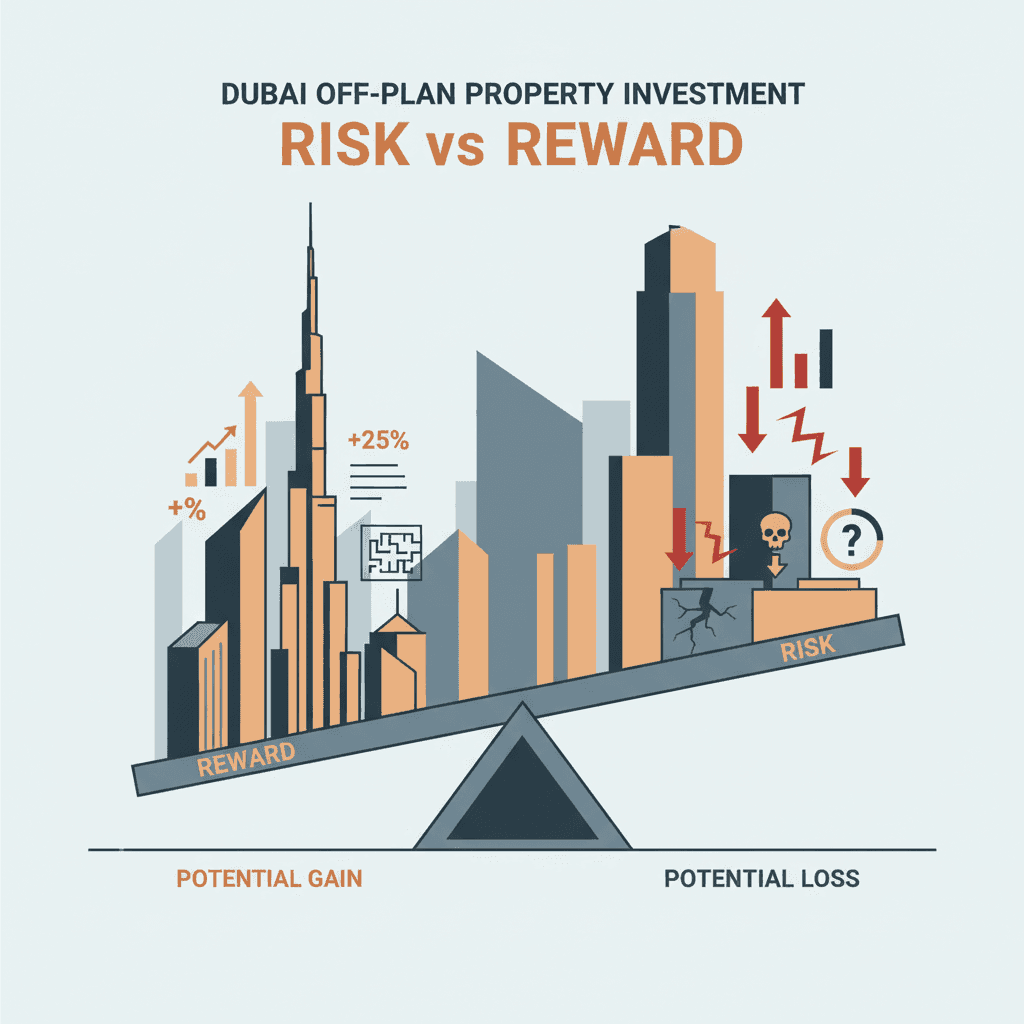
- Construction delays (off‑plan): Favor developers with on‑time delivery records; verify escrow and bank guarantees; keep timeline buffers.
- Oversupply in segments: Be selective with generic studios in peripheral zones; focus on view, layout, micro‑location, and unique attributes.
- Payment default risk: If your situation changes, communicate early with the developer; understand DLD notice periods and remedies.
- Market cycles: Prices can correct. Prioritize cash‑flow resilience and a 3–7+ year hold horizon.
Market snapshot and what’s ahead
- Growth and diversification: Expansion of freehold zones alongside more family‑friendly townhouses, co‑living/co‑working concepts, and mid‑market options complementing luxury villas and penthouses.
- Regulatory refinement: Continued focus on transparency—registration, escrow, and service‑charge oversight have strengthened investor confidence.
- Sustainability premium: Green buildings, open spaces, and smart‑energy management increasingly command higher rents and valuations.
- Human + tech: Digital processes (Oqood, e‑services, blockchain pilots) streamline transactions, but reputable local brokers and property lawyers remain essential for negotiations and compliance.
Quick picks by goal (areas to consider)
- Income‑focused: JVC, Arjan, parts of Business Bay, select towers in Dubai Marina with efficient layouts and competitive service charges.
- Appreciation‑focused: Early phases in Dubai Creek Harbour, Dubai Hills Estate, Meydan, and waterfront micro‑locations like Emaar Beachfront or Bluewaters.
- Family living: Arabian Ranches, Emirates Living, Dubai Hills Estate (schools, parks, clinics nearby).
- Iconic addresses: Downtown Dubai, Palm Jumeirah, select Marina/JBR and Business Bay towers for global tenant appeal.
Fast answers to common questions
- Can foreigners buy freehold property in Dubai? Yes—within designated freehold areas.
- Do I need to visit Dubai to buy? Off‑plan can be completed remotely; ready transfers require you or your authorized representative at a DLD Trustee Office.
- What proves ownership? For completed property: DLD Title Deed. For off‑plan: SPA + Oqood certificate until completion.
- Typical service charges? Commonly AED 10–20 per sq ft/year; higher for resort‑style and ultra‑prime assets.
- Can I resell before completion? Often after paying 30–35% (developer‑dependent; check your SPA).
- Are Dubai yields higher than other global cities? Frequently yes—~5–8% gross is common for well‑selected units, but results vary.
Quick checklist before you buy
- Confirm designated freehold status and clean title (no encumbrances).
- Get mortgage pre‑approval (if financing) and a full written cost breakdown.
- Use a RERA‑registered agent; consider hiring a property lawyer.
- For off‑plan, verify the escrow account, Oqood registration, and developer track record.
- Review service charges, community rules, parking, and short‑term rental policies.
- Schedule an independent inspection/snagging; confirm handover and defect liability timelines.
- Understand your visa options linked to property value and type.
Bottom line
Freehold property in Dubai gives you true ownership in a transparent, well‑regulated market with compelling rental demand and potential visa benefits. Your best results come from rigorous due diligence, conservative financing, and working with qualified, RERA‑registered professionals. Verify the latest fees, visa thresholds, and regulations with official sources, and you’ll be positioned to secure a quality asset in one of the world’s most dynamic real estate markets.